
Ulster Orchestra & The Belfast Ensemble; composer: Conor Mitchell
Ulster Hall, Belfast
“The sun still shines”. The statement is both a blindingly obvious declaration of fact and the deeply philosophical, final words spoken by a young German woman called Sophie Scholl, as she was led away for execution on 22 February 1943. She was 21 years old.
While she was studying at Munich University, Scholl co-founded the White Rose underground movement, a grouping of student activists, who, through the distribution of leaflets and graffiti slogans, urged their fellow citizens to rise up against the Nazi regime, denounce the mass murder of Jewish people and call for an end to the war. What began as a modest political protest would have profound, far-reaching consequences, as these young people squared up to the authorities, fearlessly speaking truth to power.
Scholl’s name is little known outside Germany but her remarkable story has inspired an ambitious new symphonic work by the Belfast composer Conor Mitchell. The Ulster Orchestra’s world premiere of Riot Symphony, on 10 May at Belfast’s Ulster Hall, will be presented in partnership with Mitchell’s Belfast Ensemble. The conductor is Gabriel Bebeşelea, principal conductor of the George Enescu Philharmonic Orchestra in Bucharest and artistic director of Musica Ricercata, the period instrument ensemble and festival.
The piece, which incorporates video inserts and texts by Scholl and the Russian punk activists Pussy Riot, is the third collaboration between Northern Ireland’s long-established symphony orchestra and the young turks of the Belfast Ensemble.
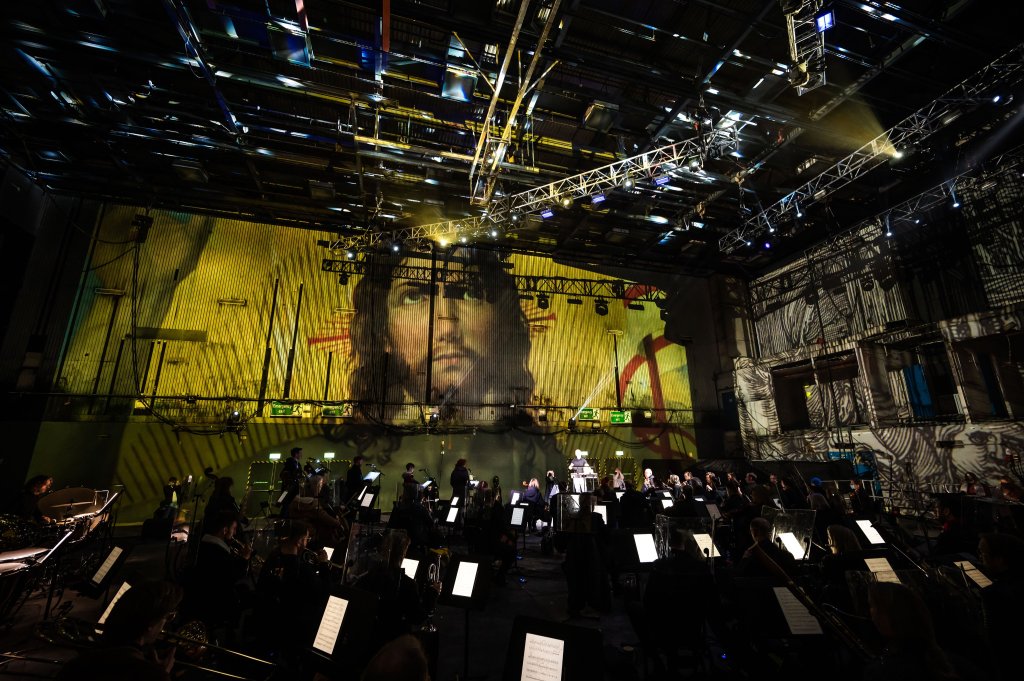
In 2021, in the vast space of the former Belfast Telegraph print room, they collectively delivered Mitchell’s MASS, a spectacular multi-media promenade piece, wrapped around by large scale projections of queer film content from all over the world. In 2020, during the pandemic, they jointly produced Democracy Dances, a filmed work for video and orchestra, which explored the so-called umbrella protests in Hong Kong and responded to the minimalist music of American composer John Adams.
With the days ticking by to the big night, Mitchell is working punishing hours on the slow, painstaking task of orchestrating a full scale symphony.
“Orchestration is horrific”, he says. “It’s like, every day trying to write out the works of Shakespeare, with a pencil. Composing symphonic music takes forever because it’s vertical. You’re creeping forward very slightly, moving vertically but with height, because of all the instruments. Plus, I’m trying to work patterns and loops into the first movement, so it’s tricky. And then there’s the vocal music, of course.”
This explosive new work for soprano, tenor, orchestra and video installation, is the latest of Mitchell’s politically charged explorations of current issues, through music. The avenue opened up in 2012 with his Requiem for the Disappeared, which he described at the time as “… a musical reflection on the issue of the right to burial. I wanted to compose something that would embody the funeral rite for people who didn’t have one. If you’re a composer, the only way you can speak up about this kind of thing is to write a piece of music”.
In 2019, through Abomination: A DUP Opera, he tackled the thorny subject of homophobia in Northern Ireland’s political discourse, via a subversively camp, scathingly comedic, verbatim filleting of former MP Iris Robinson’s shocking outburst during BBC Radio Ulster’s Stephen Nolan Show. Hugely successful on home territory, it was rapturously received at London’s Southbank Centre and Brighton’s Theatre Royal last year, when one critic described it as “… a modern operatic masterpiece.”
The journey is about to continue with Riot Symphony, described in publicity material as “… a musical celebration of youthful protest and activism”.
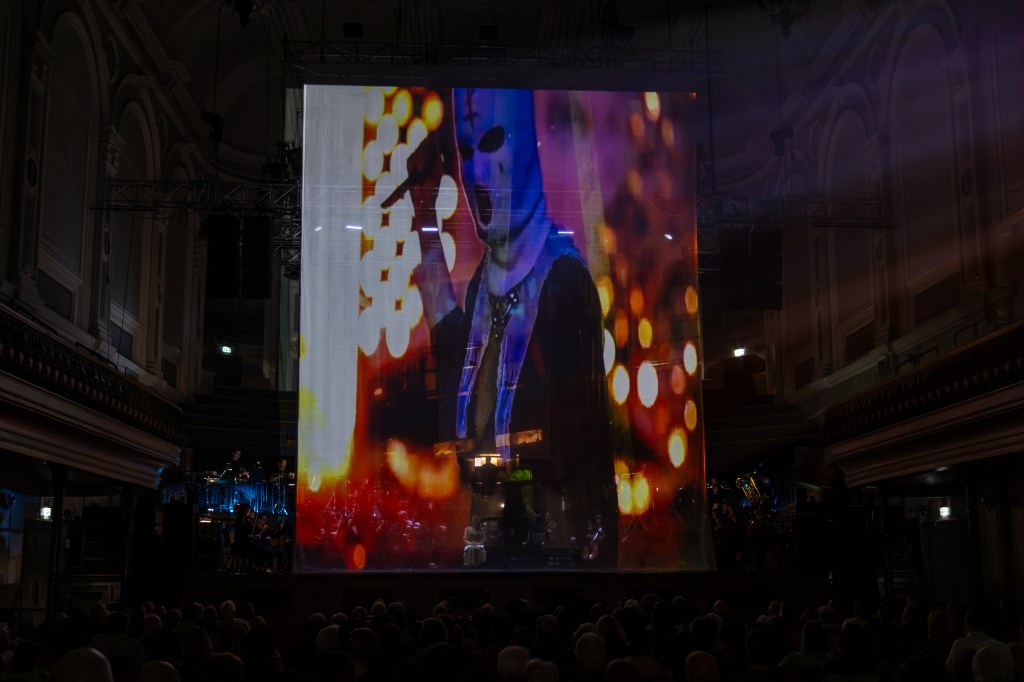
“What inspires me about people like Pussy Riot and Sophie Scholl is their youth,” says Mitchell. “That’s part of the challenge of the music, because I want the first 20 minutes of the piece to be bright and full of energy. I remember what it was like to be sixteen and wanting to change the world. We had this feeling of invincibility and optimism. It was a time that seemed so fast and hopeful.
“It’s the same fearless youth and energy as Greta Thunberg chaining herself to a railing, and the student protestors in Paris in 1968. There’s an electricity about that, a fire, a spirit that I want to capture. I find what Sophie and her colleagues did at that time to be absolutely brilliant and the writing in the leaflets is stunning, really beautiful. They were scholarly leaflets, which talked about how you would feel after the war, if you had done nothing. It was a total guilt trip. They repeatedly used that word, ‘Guilty, guilty guilty.’
“I’ve always been very taken with protest. Years ago, I was writing a piece, set in Germany, about the Rosen Street protest in Berlin and it was in my research that I first came across Sophie Scholl and the White Rose. This demonstration was organised by the non-Jewish wives and relatives of Jewish men, who had been targeted for deportation. It continued for seven days until the men were released by the Gestapo. It was the only public protest by Germans in Germany during the war. It’s really important to get stories like that out there”.
When it comes to using music as a tool for political protest, there are few who can equal the chutzpah of the Russian band Pussy Riot. Mitchell, an unashamed fan of their work, contacted their record label and asked permission to use one of their tracks as an orchestral overlay. To his surprise, they promptly came on board.
“We’re going to rip out the vocals from the audio and superimpose them on the orchestra, for a moment. I am hoping that one of them will come to the concert, but I realise that would not be easy. What they do is awesome. We talk a lot about Northern Ireland’s punk music, but realistically Pussy Riot was the essence of punk”.
The Russian invasion of Ukraine is another point of reference in Riot Symphony. And most recently, the world has seen, amongst other horrors, the murder of Alexei Navalny and the war in Gaza. Mitchell says that there are times when an artist has to run fast to keep up with real life. The Headless Soldier, his chamber opera set to texts by playwright and long-time collaborator Mark Ravenhill, played at the Lyric Theatre during the 2023 Outburst Queer Arts Festival. It explored modern day prejudice, hatred and dissonance, with footage from the bombing of Gaza integrated into the video imagery.
“Time and again, you see the silencing of voices, as with Navalny, as with Sophie Scholl,” says Mitchell. “The reality is that these voices of opposition rise up and are then done away with. What’s left is a vacuum. I’ve been really interested recently in the way that people are rising up under the surface, with flash riots and flash protests, a lot of them led by young people, taking to the streets to make their opposition known. You saw it with the umbrella protests and, massively, with George Floyd. They are empowered by their laptops and mobile phones to express their political beliefs in a way we never did.”
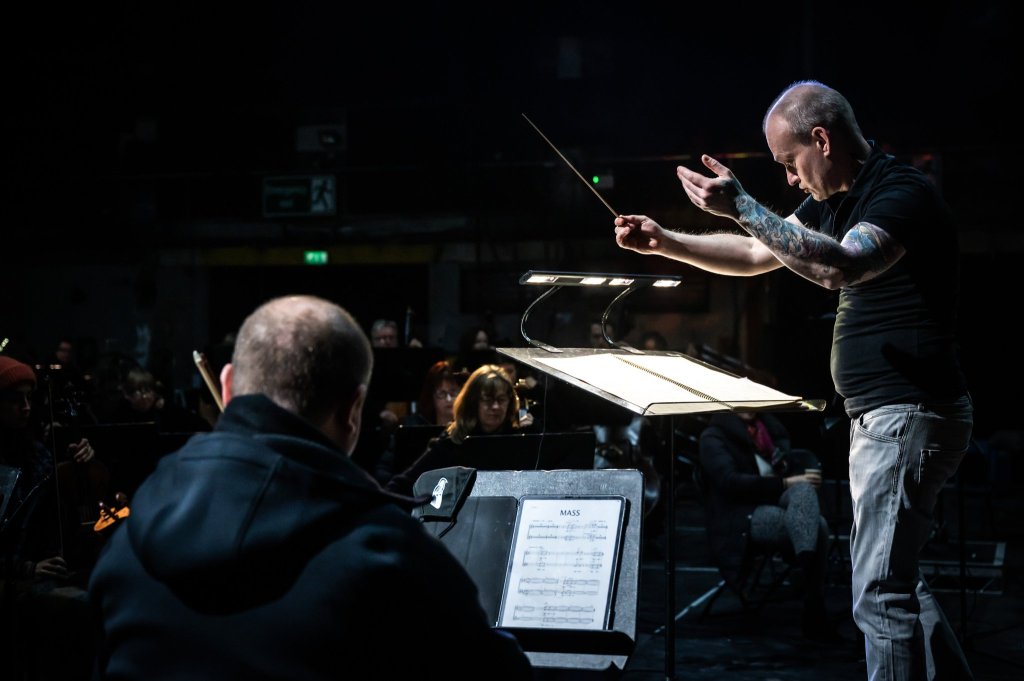
Riot Symphony is an explosive, high concept protest work. In the style we have come to expect from The Belfast Ensemble, it is something entirely different. Mitchell is full of praise for the way in which the orchestra has opened its doors and its mindset to the challenge of joining him on these ground-breaking musical journeys.
“I remember when we did MASS, everyone said the orchestra was going to be very difficult. You’ve put them in this cold venue with no heating, you’re shining lights in their eyes, we’re just coming out of Covid and they’re not going to want to be there. Nothing could have been further from the truth. They saw it as an adventure, with a completely new audience. They were being steered in a direction that was much more modern and they completely went for it”.
Patrick McCarthy, the orchestra’s deputy chief executive and artistic director, describes these shared projects as ”… vital and profound. Conor’s work has brought a new social conscience to what we do. Riot Symphony is an exciting new co-commission for the two partners and this promises to be a hugely significant evening in our Ulster Hall home.”
World premiere of Riot Symphony, Ulster Hall, Belfast 10 May 2024 https://www.ulsterorchestra.org.uk/whats-on/the-sun-still-shines/
https://www.thebelfastensemble.com/
This article first appeared in The Irish Times on 4 May 2024

 The Even Hand