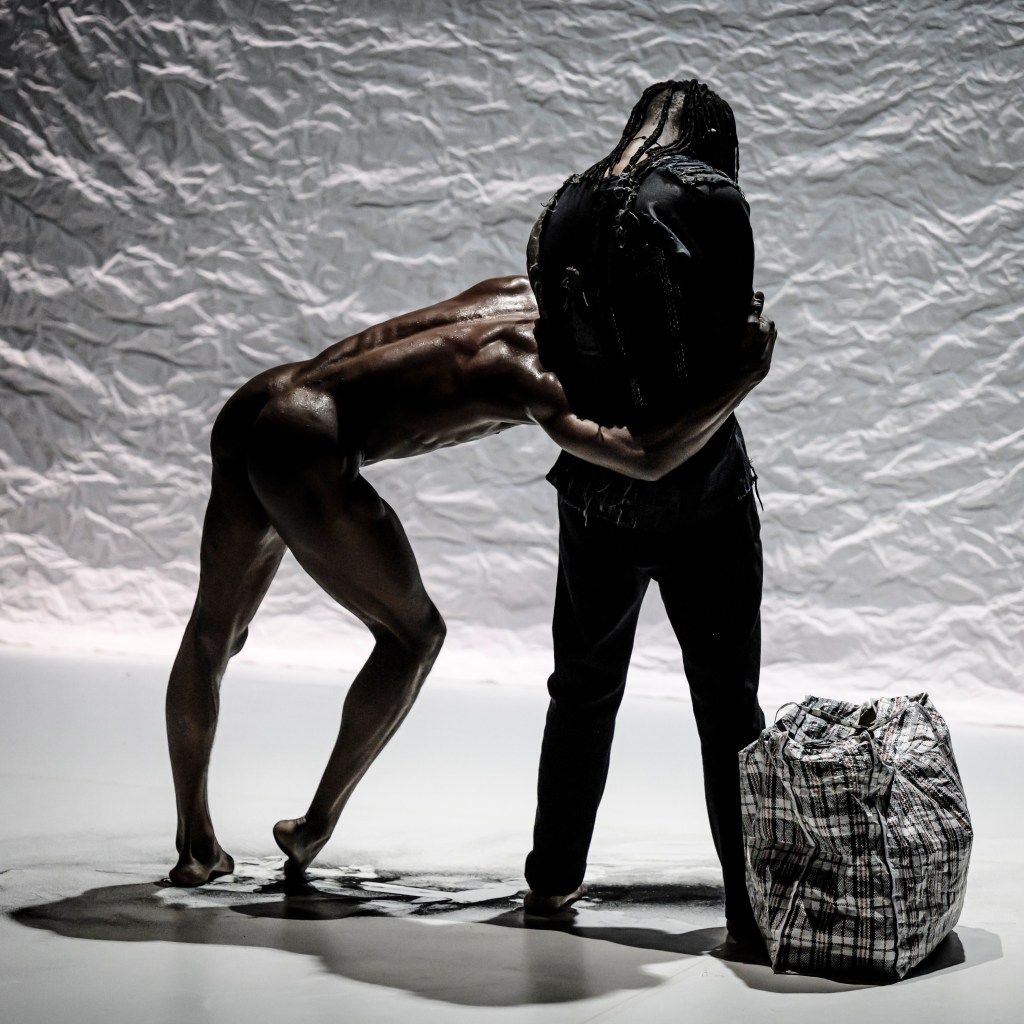
Impasse – The MAC, Belfast: 6 November
The Gate House – St. Anne’s Cathedral, Belfast: 2 November
2024 Belfast International Arts Festival
The second week of the 2024 Belfast International Arts Festival has seen the emergence of two important dance initiatives.
Impasse is a powerful, intense examination of Black physicality, identity and cultural heritage, choreographed by dance artist Mufutau Yusuf, who was born in Lagos and grew up in rural County Meath.
Twenty years later, his return to Nigeria prompted this intimate exploration of the black diaspora experience. Starting with his own complex identity and upbringing, he portrays, by way of examples, black people as slaves, migrants, casual workers, fugitives, warriors, social outcasts.
Now based in Dublin, Yusuf is the recently appointed choreographer-in-residence of Luail, the newly established National Dance Company of Ireland. It has has grown out of the renowned Liz Roche Company, which originally commissioned and produced this work. At the Belfast launch of the company, Luail’s artistic director Roche said:
“There has never been an all-island dance company in Ireland before. In order for this to be truly meaningful and authentic, Luail will develop a strong foundational partnership with Maiden Voyage Dance in Belfast. The name Luail means movement, motion, energy, impulse and is grounded in the belief that dance is a vital pulse of human creativity, connecting people and ideas, in understanding and re-imagining the complexity of our shared island.”
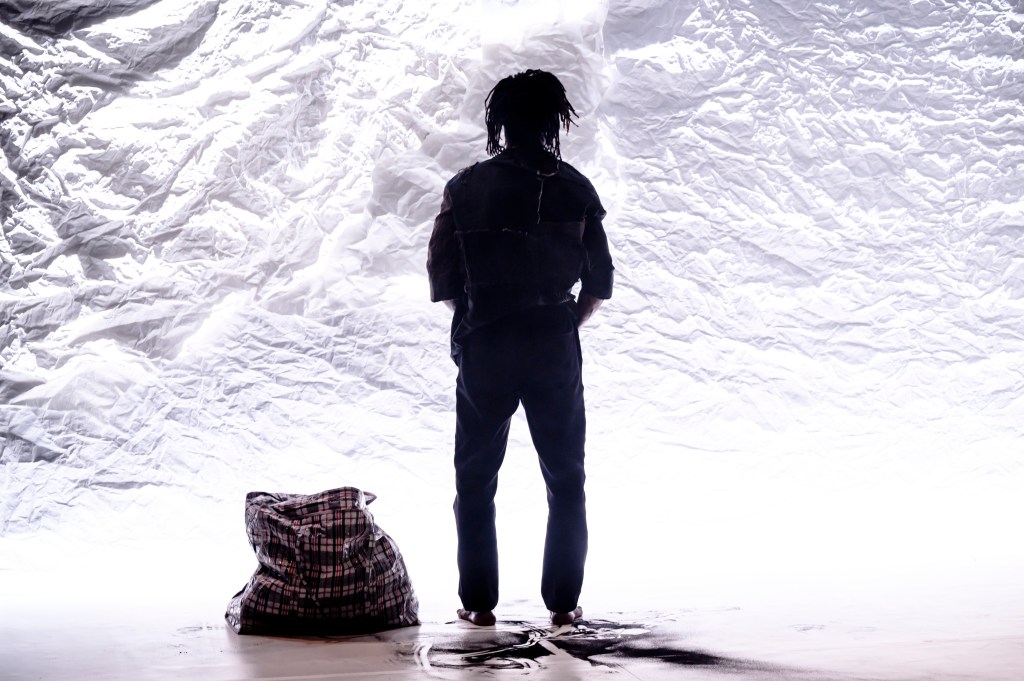
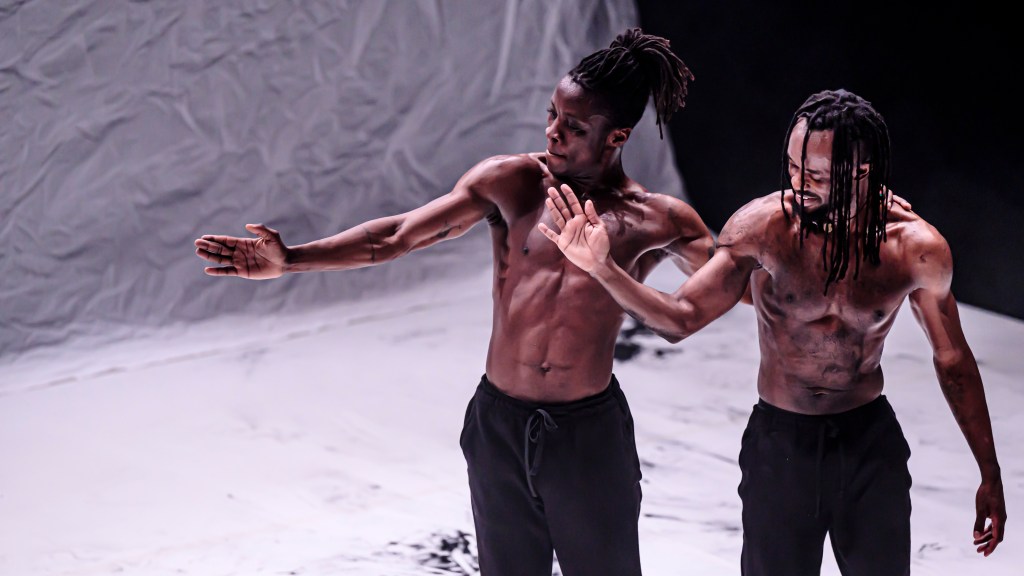
In Impasse – meaning a cul de sac, a one-end street – Yusuf’s unrelentingly physical choreography demands, and receives, nothing more than a bleak, bleached, minimal set which encloses the gruelling, directionless journey of two men, unconnected yet mutually dependent. Similarly, props are few but speak volumes.
The piece begins with a sinewy, swaying ritual dance, performed by a towering figure in a traditional-style robe, made from the cheap, brightly patterned hold-all bags that are a staple element of the migrant’s uniform. The presence of one of those bags will, in turn, double as a burden, a comfort blanket and an indispensable travel accessory.
A rough, forbidding, pearly-white cliff face throws Yusuf and Lukah Katangila’s lithe bodies into stark relief, as they embark on a pounding, pulsating journey into the unknown. To a heady soundscape of hip-hop and classical music, neither dancer breaks step or unified rhythm throughout the one-hour performance.
Just as the audience is beginning to flag with the uncompromising pace and energy bouncing off the stage, a vibrant patchwork quilt is unfolded and hung across the cliff face. Its joyous colours, its myriad images, its sense of celebration signal the end of the road and offer a thrilling tribute to the power of art to pull humanity through the toughest of times.
*
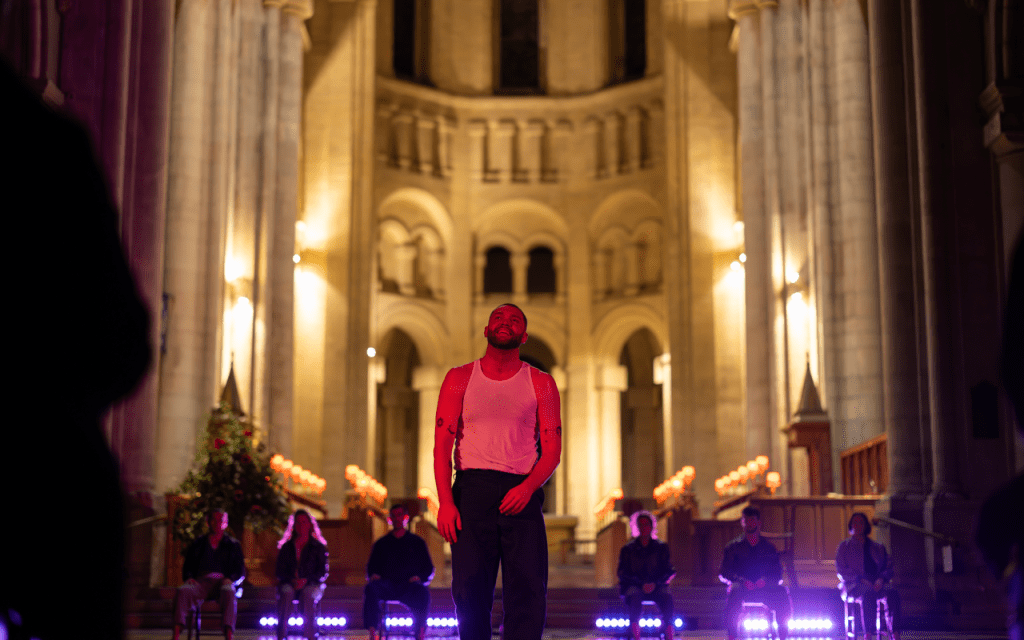
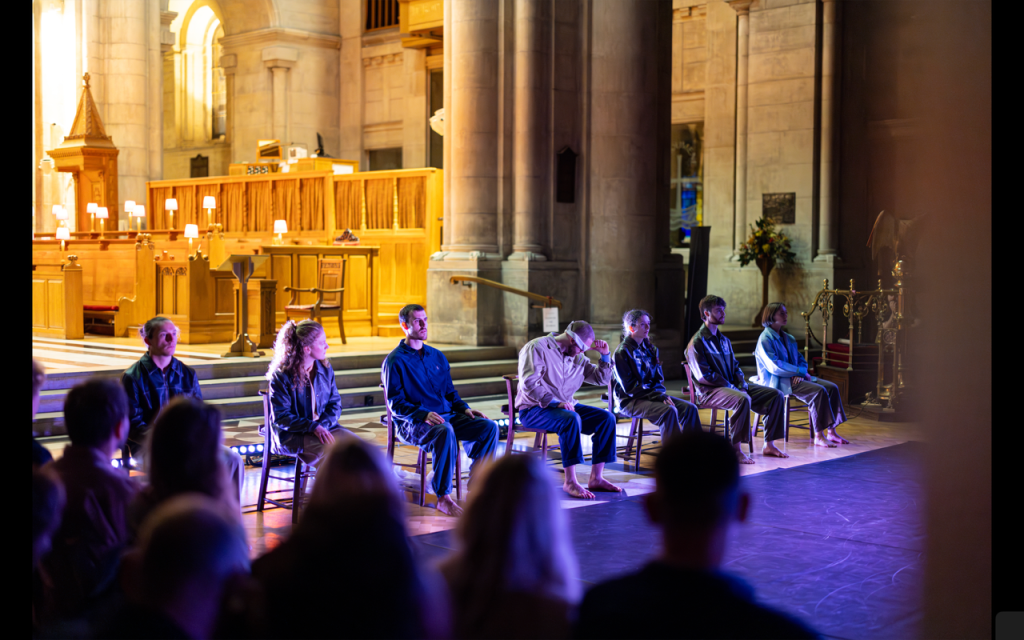
The Gate House is a new, deeply personal dance piece by the emerging Belfast company Northern Attitudes, presented in the majestic, arched nave of the city’s St. Anne’s Cathedral.
Its skilfully co-ordinated presentation, blending live music with thematic narrative and dance, evolves from a string of real-life episodes relating to three generations of director/choreographer Michael McEvoy’s family. Performed by a company of seven dancers (Diarmuid Armstrong, Angus Bartlett, Clara Kerr, Michael McEvoy, Rosie Mullin, Oliver Robertson, Hannah Scully) in street clothes, his vibrant collage of images and reminiscences spools forwards and back through the family’s religious/cultural history and the events that surrounded them.
Clues to its road map lie in the title. McEvoy’s grandfather worked for the internationally famous Guinness company, whose headquarters are at Dublin’s St. James Gate. His father was a roofer, who regularly carried out renovation work on gate houses, built during the Irish plantations to protect the estates of wealthy landowners. As a teenager, McEvoy would sometimes help his father, who offered him a job, while realising that his son’s preference was for dance and drama, rather than rough, manual work.
A touching prologue singles out a sensitive child, who opts out of Saturday morning football in favour of dancing and chasing butterflies around the goalposts. A boy who always felt somehow different and apart.
Joshua Burnside’s atmospheric, traditional-flavoured songs and instrumentals ring out sweetly in the cathedral’s acoustic splendour, providing clear inspiration to the variety of dance styles and influences McEvoy threads through his storyline.
A patchwork of scenes unfolds: the sectarian conflict surrounding the Peace Walls, Catholic rituals and family worship, summer camps with Protestant friends, fireside storytelling sessions, the violence of the Belfast progroms, the emotional trauma of the Troubles.
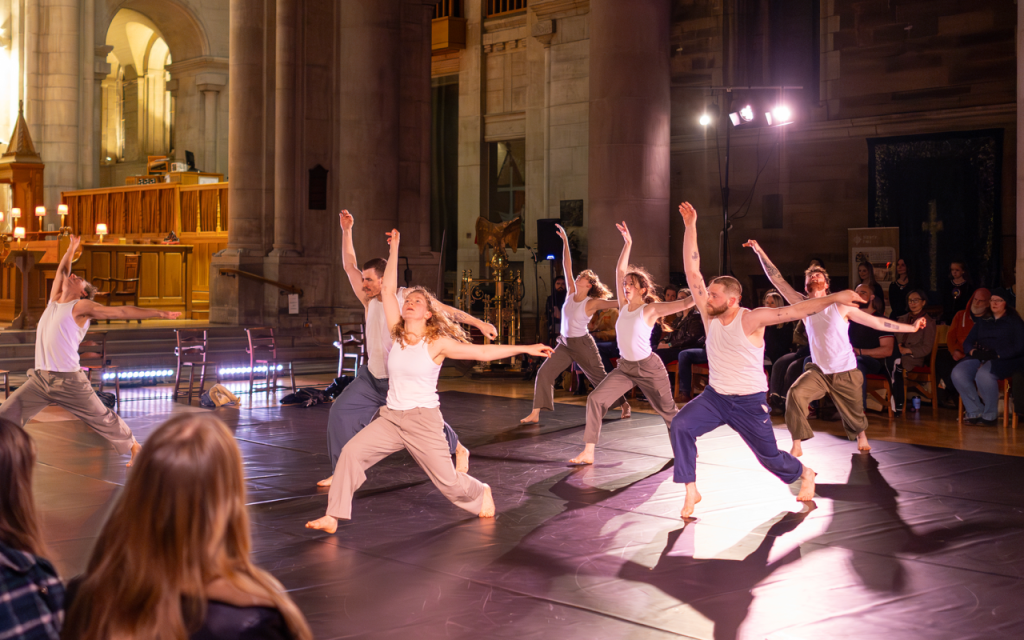
In a spontaneous change of pace and mood, Clara Kerr (who has just been invited to join the Luail company) explodes into a celebration of Irish history and culture via a new piece Ta Bron Orm (I Am Sad), choreographed by herself and Denise Catney and performed by a colourfully-costumed group of young dancers.
And then it’s farewell, as the peace-baby generation takes its leave of the past and heads off into a future brimming with optimism and hope. It’s an apt metaphor not just for the piece but for the creative ambitions of this inventive young company and its artistic director.
Impasse: Photographs by Neil Harrison
The Gate House: Photographs by Neil Hainsworth
http://www.belfastinternationalartsfestival.com

 The Even Hand