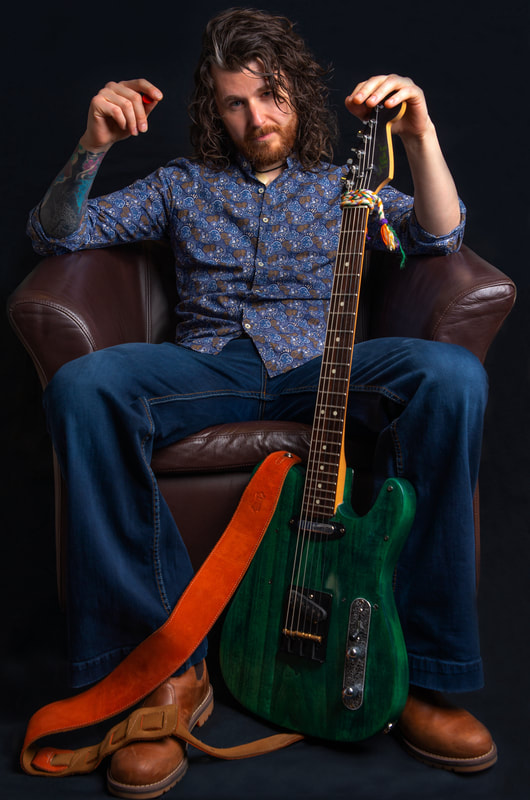
In conversation on the eve of his Buried Alive UK and Ireland tour
In 2017, an unknown, 27 year-old blues guitarist from Antrim called Dom Martin stepped on stage at an open mic session in a local golf club. For years, he’d been playing free gigs in pubs and bars around the North. Life was tough. There was no money coming in. He talks openly about having to live in the same ill-fitting clothes, struggling to provide for his former partner and their son Luca, who is now six. What kept him going through it all was the music, which was, and remains, his lifeline, his reason to exist.
On that night in the golf club, he was spotted by someone who made a call to a friend of a friend with connections in the music industry. From that point, everything changed. Under the management of Fenton and Audrey Parsons of Red Pepper Promotions, Martin’s fortunes have taken an upward turn. The couple have become his saviours and quasi-parents, guiding him through the minefield of the business, organising his tours and helping to shape his burgeoning career.
Since releasing his debut studio album Spain to Italy in 2019, he has won six UK Blues Awards for best solo artist, best acoustic blues act, best instrumentalist and best album. In 2022, he was inducted into the UK Blues Hall of Fame and has been hailed by critics and fellow musicians as “… a rare talent of sheer genius”; “… the next rising star in the global roots scene”; and “… a unique, genuine, vital artist”. After his first live appearance on her show, BBC radio presenter and former Catatonia vocalist Cerys Matthews described his music as “… absolutely wonderful stuff”.
In 2022, his second album A Savage Life (his surname is Savage) propelled him into the UK and European blues rock scenes and, last year, his third album Buried in the Hail was voted Blues Album of the Year in the UK Blues Awards. It was produced by Grammy-nominated Dublin producers Chris O’Brien and Graham Murphy, mastered in Limerick by Richard Dowling and recorded in Portlaoise’s Golden Egg Studios.
Last month, he returned from a string of solo gigs in Belgium, Germany and the Netherlands to play at the private launch of the auction of his hero Rory Gallagher’s collection of guitars, amps and accessories at Bonhams Auctioneers in London.
In the auctioneers’ magazine, music journalist Neil McCormick wrote: “Rory was one of the all-time great blues rock guitarists, with an aggressive yet lyrical touch that made the instrument burn under his fingers”. Similar sentiments have been expressed about Martin, a compliment he finds a little overwhelming.
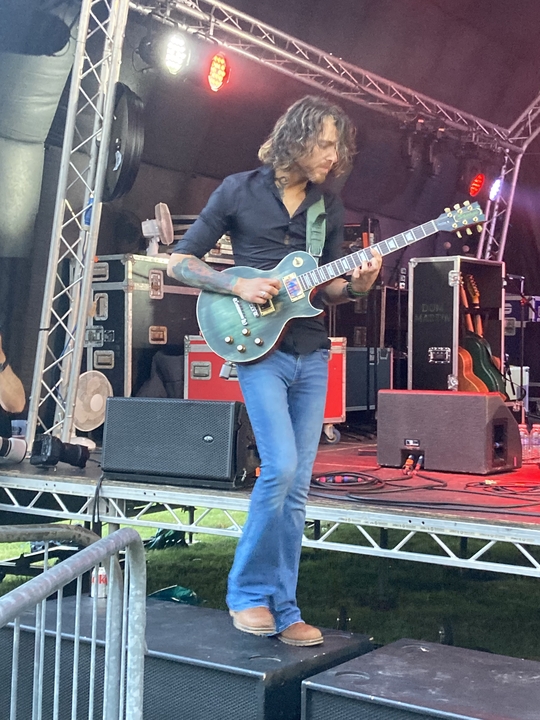
“Rory is my idol”, he says. “I look up to him as a person, as well as an absolutely incredible musician, singer and songwriter. He blazed his own trail and that made him a better man. He played places other people didn’t. His music was raw and unpolished and was never about making political points. Yeah, he was just himself”.
After pausing for a few days in his cottage on the Ards peninsula, Martin is back on the road to promote his new live album Buried Alive. Along with band members, bassist Ben Graham from Portrush and Donegal drummer Aaron McLaughlin, both classically trained musicians, he has just kicked off a UK and Ireland tour, which will include six dates on this island.
With his high octane sound, his wild-haired stage presence and fearless playing style, one might imagine a swaggering, flamboyant real-life character. But the opposite is the case. Martin is soft-spoken, gentle and self-effacing, exuding the vibe of a man who can’t quite believe the way his life has turned.
“God only knows where I’d be but for Fenton and Audrey,” he says. “They have literally saved my life. I had a crazy upbringing. I didn’t do school. I only went for the free lunch and then headed home. Eventually I opted out altogether. My parents were lovely people but not great at child rearing. They’d had terrible childhoods themselves and had no role models to learn from. Then they had five kids – and we’re all mad! I don’t know how they coped. I’m the middle one. I still look out for my younger brother and sister but I have virtually no contact with the older ones”.
He grew up a shy, introspective child in a mainly Protestant town, 20 miles from Belfast. He describes the neighbouring streets as ‘outlaw country’, where, in the years after the Troubles, communities lived under the cosh of criminals, paramilitaries and drug dealers. As a teenager, he kept his head down and did not stray far, spending all his waking hours listening to and playing music passed on to him by his father, the guitarist and songwriter Micky Savage.
Apart from a guitar, which his father gave him when he was little more than a toddler, nothing has been handed to him. The first song he taught himself to play was Ralph McTell’s Streets of London, concentrating on the finger picking sequences, while trying to sing at the same time. Years later, that same gifted boy would find himself sharing the experiences of some of the troubled characters captured in McTell’s poignant lyrics, and pouring them into his own songs.
“Those experiences are where my songs came from”, he says. “I’m open about that. I mean, from their very beginning, the blues were born out of trauma. There was a lot of judgement at the time about the drink and the drugs, from people who didn’t know my dad. You get treated a little bit differently. But … it is what it is.
“Music is not just total immersion, it’s a switch-off. It’s like breathing. I live on my own, which is entirely my choice. The only way I can function as a human being is to be alone. I’m socially awkward and anxious. I’d rather be alone than make friends. Even as a child, if someone came to the house, I would pick up the guitar and play, as a way of saying, ‘Look at me, I’m saying hello to you’.
“I see my boy Luca as often as I can. He lives with his mum, not too far away but I miss him. I’m trying to learn from my father’s mistakes, to do the best I can for him. I live pretty frugally and the only reason I want to make money is to improve his life.
“It would be easy for me to paint my dad in a bad light. He was both a good and a bad influence on me. He was dragged up in Belfast during the Troubles anD lost both his parents by the time he was ten. For all his faults, he was a great guy and I miss him every day. But he was a nightmare to live with. He drank and smoked too much and wouldn’t change his ways for anyone. I was privileged to care for him through serious illness for the last years of his life”.
From a very early age, Martin figured out that the only way he could bond with his father was through the guitar. He also admits to taking on his smoking and drinking habits, as well as whatever drugs he was using. He says his father would be proud that, under his own efforts, he is now sober, clean and healthy, and never takes a drink.
“ When I was little, we would listen to stuff together and he noticed that I loved the blues”, he says. “My first introduction was through Pink Floyd’s Meddle album. Then he put me onto Rory and Howlin’ Wolf and Muddy Waters, John Martyn, John Prine, Zeppelin, Dylan, McTell … all those guys. I’ve kept every one of those records, they’ve been part of my daily life since I was a baby. My dad played those songs on guitar. He was a brilliant musician. By imitating him, I learned so much”.
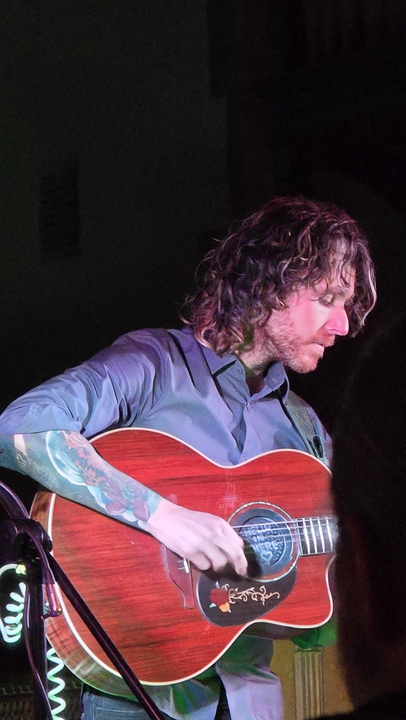
From his present vantage point he looks back philosophically on the gigs he has played, in bars, in clubs, at festivals and on blues cruises, and as support to legendary artists like Joe Bonamassa and Eric Gales. If he plays a bad one, he takes it on the chin and learns from it. He lives in the present and nurses no lofty ambitions, except to be a better guitarist, write better songs and be a better father. But there is one gig that has no equal.
“Playing at the Rory auction was a once-in-a-lifetime experience”, he says. “I got to hold his Strat, I even got to play the Esquire and his 1930 National Triolian Resonator. I’d been looking for that guitar for about 25 years. Since I was a kid, I’d been addicted to the songs he played on it. I wanted to see it, I wanted to touch it and play it. When I saw all those guitars and stuff on display, I couldn’t stop shaking.
“All through the gig, I was really anxious about playing those songs that Rory wrote, to do him proud in front of his family and the crowd. We were all there because we loved Rory. It felt like I’d been practicing for that moment all my life. I think we did okay. I feel like I’ve achieved something now and I can move on to something else. I was very, very privileged to be there.”
Further information and 2025 gigs: http://www.dommart.in
An edited version of this article was first published in The Irish Times on 14 November 2024.

 The Even Hand