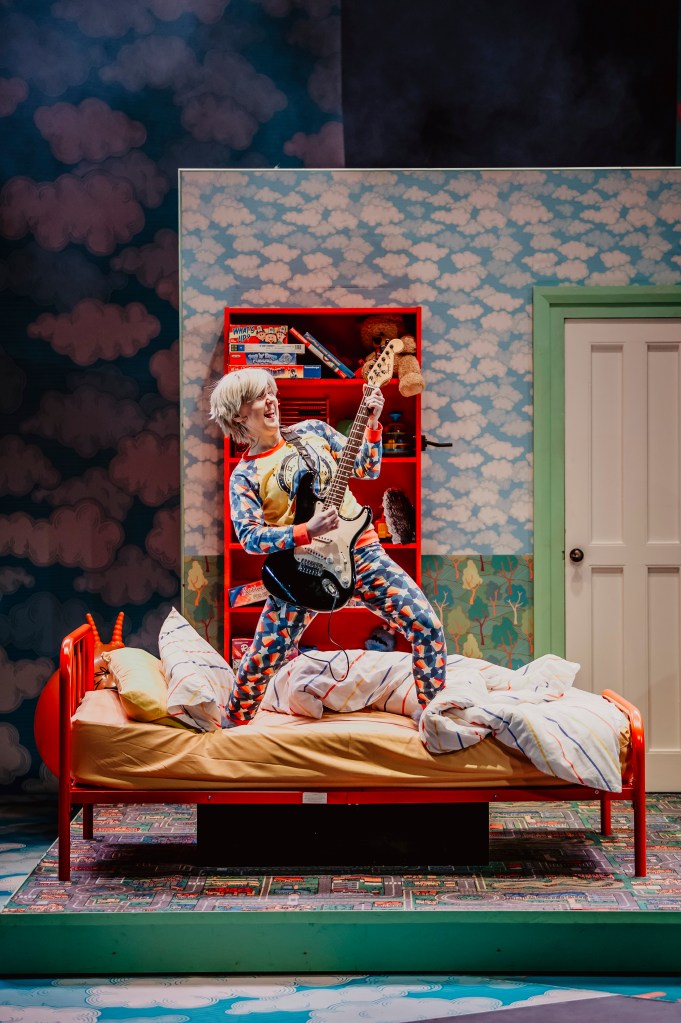
Lyric Theatre, Belfast – 14 to 30 March 2025 for 27th Belfast Children’s Festival
What happens when a Victorian children’s classic is put into the hands of an enigmatic, self-confessed ‘curious’ musician and an award-winning author, whose work is infused with dark imaginings and magical realism? The result is an updated, slightly subversive musical version of Margery Williams’s The Velveteen Rabbit, the story of a boy, his favourite toy, and how love makes us real. It was published in 1922 and is, to this day, a favourite book for bedtime.
Writer Jan Carson and singer-songwriter Peter Wilson (aka Duke Special) are collaborating on this first-time co-production between Replay Theatre Company, which specialises in creating theatre adventures for young audiences, and Belfast’s Lyric Theatre. Carson has relocated the storyline to a nursery in 1980s Northern Ireland, where a collection of mischievous toys drive the action. It will receive its world premiere later this month at the 27th Belfast Children’s Festival, the biggest children’s festival in Ireland and the UK.
During a break on the first day of rehearsals, Carson and Wilson are buoyed up at the prospect of the piece beginning its final journey towards the stage. They have spent the morning listening to the cast reading through the script, having sight of the set model and costumes and, in Wilson’s case, identifying song segments which may require a bit of a tweak.
Neither had read The Velveteen Rabbit as children. Having done so for this assignment, they took differing approaches to the tasks in hand. It is Carson’s first stage play and her first adaptation of another writer’s work. In contrast, Wilson has notched up seven theatre credits, the first of which was the music for Deborah Warner’s critically acclaimed 2009 production of Mother Courage and Her Children at London’s National Theatre, in which Fiona Shaw played the title role.
Each of his melodic songs constitute small dramas and address a vast range of subjects, situations and personal experiences, delivered in a style inspired by vaudeville and music hall. In his earlier days, he cultivated an unmissable bohemian persona, sporting long dreadlocks and thick eyeliner. Nowadays, he’s just himself, softly spoken, thoughtful, impishly funny. He admits to an ongoing curiosity about music, theatre, books, poetry, art, love, life, redemption, death and 78RPM records.
Carson grew up in a Presbyterian family in Ballymena, an environment which has strongly influenced her writing. She has said that her main reason for writing magical realism is because the Bible was her primary storyteller text, a narrative grounded in the real world, where strange things happen. As a child she devoured the books of the English writer Joan Aiken, whose alternative history novels for children resolved real events in a different way from the history itself. The tone and content of Aiken’s stories were far ahead of their time, and influenced Carson’s approach to adapting a book, which she admits did not greatly appeal to her.
“I found it a wee bit moralistic and it does not have a particularly happy ending for the wee rabbit”, she says. “I was trying to start with that as a place to build from, to think about what I needed to change and adapt for a contemporary audience. So I’ve gone for a slightly less abrasive ending. I don’t think young kids nowadays would enjoy the prospect of the rabbit being destroyed. Kids are not stupid and, for sure, in Northern Ireland in the 1980s, children would have known all too well about people being killed. It was important for me to write in a way that I’d have wanted to hear as a child”.
Wilson talks about the smooth collaborative process which is evolving in the rehearsal room. Both he and Carson are struck by the fact that no artistic compromises are being made in terms of the quality of this work for young audiences.
“With the songs, you could easily go down the route of making ‘children’s music’, just primary colours, watered down, like fluff”, he says. “But I always want melodies to be memorable. It’s nice now to try and find a bit of complexity in the music, not to make it totally spoon fed just because of the age of the audience.”
In spite of her misgivings, Carson acknowledges The Velveteen Rabbit’s influence on films like Toy Story, and pinpoints themes in the book that remain pertinent to today’s world.
“There’s a song that Pete has written, which we were singing today”, she says. “It’s called Nobody is Real, with a line that nobody gets to be real. It’s repeated over and over again. The resonance of that line in 2025, when kids are facing questions about what is truth, what is real, is really powerful and comes from a book that is over 100 years old. It’s a slim book, but there are lots of characters and lots of things going on, so the biggest task has been in deciding what to take out and what to leave in”.
From the perspective of having worked previously on a wide variety of stage adaptations, Wilson articulates his own observations on his role in the process.
“I’m lucky because, in the past, when I have responded to or adapted other people’s work, I can change fragments and cherry pick things that particularly resonate with me. I don’t have to tell or re-enact the full story, whether it’s responding to poetry or the visual arts or whatever. It’s almost like what I am creating is abstracted from the original. I’m not the one who has to create the story from beginning to end. I get to look at what went before, then walk around the new version and find things in it that I can react to.
“So, the process is the same, but always different. In the read-through today, I’m hearing the songs in context and picking up on things that need fixed. There needs to be well thought-out punctuation of where the music goes and how the songs fit in. I’ve spotted a few holes but we have plenty of time to sort them out.
“With any adaptation or translation, it’s interesting to see what survives, what speaks to people today with any relevance or consequence. That’s the challenge, to see what bits you pull out or what bits you highlight. Depending on the decade, different lines might jump out at an audience in different ways.”
The two then proceed to trade cultural references from their own childhoods, their favourite toys, television programmes, music and books.
“Pete’s music feels very nostalgic to me,” says Carson. “There are nods to The Magic Roundabout and to what feels like 1980s pop music. He’s genius at weaving all those things together. After the first time we all sat around a table reading the script and thinking about ideas for music, he went straight home and started buying Fisher-Price plastic music-making instruments from the ‘80s. I loved that because that’s my vision for this. It’s not entirely modern but it’s not Victorian either, it’s some kind of halfway house”.
“I don’t have children, I’m not a massive fan of children and I would never choose to go to a children’s play. So I had to think what it was that would persuade me to go to a children’s play, and enjoy it. It would have to be accessible and funny for the little people, but it would also have to have something for the grown-ups.
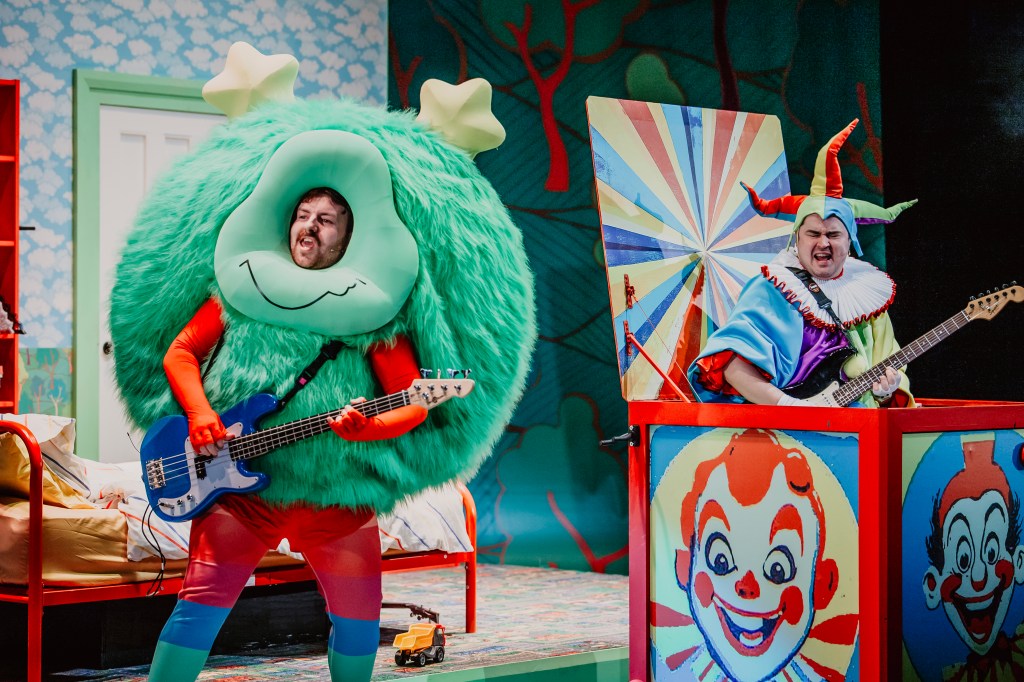
“The route into that was to set it in the ‘80s, where today’s parents would have their own references to Leisure World [a Belfast toy shop] and trolls and Teddy Ruxpin. Pete has captured that in the music, so there’s a touchstone for the adults, not only in the dialogue but in the physical humour and the way the performers move about the stage, which the children will also get very easily”.
“Regarding the ‘80s, I was there, and even further back”, says Wilson. “As well as The Magic Roundabout, there were programmes like Bagpuss and Fingerbobs, where there was a kind of sophistication to the music. That’s what’s fascinating about the creative process. You’re trying for one thing and then it jumbles and morphs and becomes different, then different again when the actors are performing it and the arrangements feed in. The music will be played live on stage by the actors. The instruments are what you might find in a children’s nursery”.
The presence of children frequently runs as a leitmotif through Carson’s novels and short stories, framing a dark, troubling context where normality is subverted and fractured.
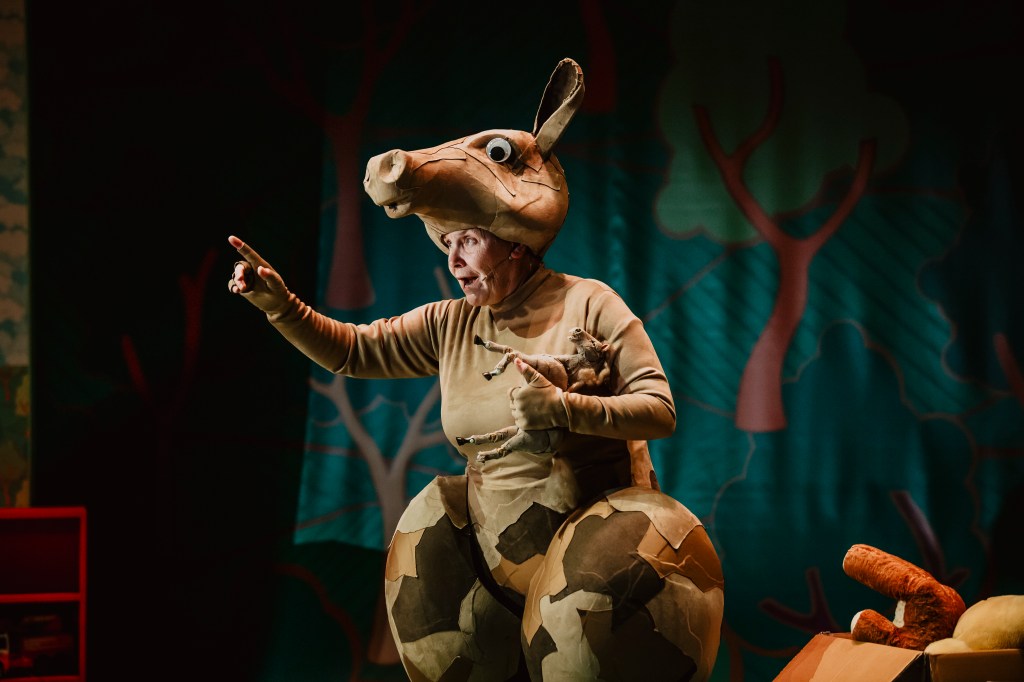
“Magical realism is set in a real place that is believable and recognisable”, she says. “The domestic setting of a nursery is exactly that. Once you make the audience believe in it, you can start to build in quirky, supernatural elements, bringing the nursery to life, with the toys singing and dancing. Kids will totally get that”.
“For songs to appear, they need to be justified”, adds Wilson. “The song is there to heighten and convey the emotion of the moment. I am interested in the idea of nostalgia and the memory of how things used to be, the things that formed you, but not, I hope, in a sentimental way.
“I find I have to rein myself in, not to make things too dark. Nostalgia can be rose-tinted but people will experience and remember childhood in many different ways. It’s about using music to make room for remembering those times, but coloured in different ways for different people”.
www.lyrictheatre.co.uk www.youngatart.co.uk
This article was first published in The Irish Times on 9 March 2025

 The Even Hand