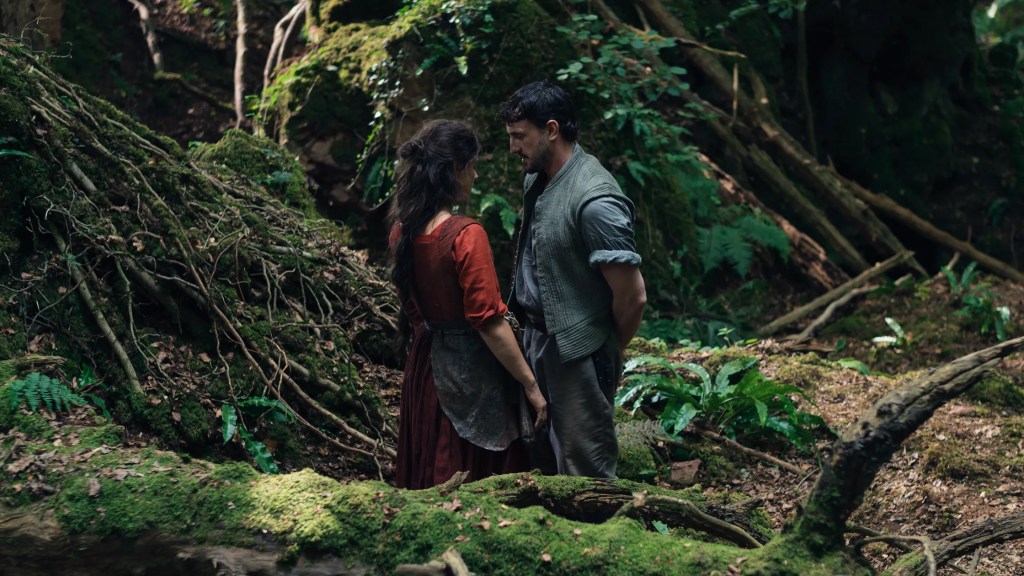
Cast: Agnes Shakespeare – Jessie Buckley; William Shakespeare – Paul Mescal; Bartholomew Hathaway – Joe Alwyn; Hamnet Shakespeare – Jacobi Jupe; Mary Shakespeare – Emily Watson; John Shakespeare – David Wilmot; Judith Shakespeare – Olivia Lynes; Susanna Shakespeare – Bodhi Rae Breathnach
Director: Chloé Zhao
While countless words have been written and numerous films made about William Shakespeare, comparatively few have shed light onto his family members.
In 1996, Peter Whelan wrote a fascinating stage drama, entitled The Herbal Bed, about Susanna Hall, Shakespeare’s daughter, who is accused of adultery with a local haberdasher. Although the writer himself is frequently mentioned, he does not appear in the play, which ends just at the moment that he is about to enter the action.
Millions of tourists to Stratford-upon-Avon will have visited the quaint thatched cottage in the village of Shottery, just outside the town, which was the home of his wife Anne – also known as Agnes – Hathaway. But again, short of knowing that she was a wise woman, a herbalist and a few years her husband’s senior, she has, until now, remained a shadowy figure in the public consciousness, little more than a footnote to the life and career of, arguably, the world’s greatest writer.
In 2020, the award-winning novelist Maggie O’Farrell wrote a historical fiction entitled Hamnet. In it, she digs deep into the tragic death of Shakespeare’s young son, an event which plunged his parents into unspeakable grief and instigated the writing of Hamlet, one of the finest and most enduring plays in the English language. Two years ago, the novel was adapted for the stage in a handsome production, staged in the round, at the Royal Shakespeare Company’s Swan Theatre. But, for all its aesthetic appeal, plus the fact that it was taking place in the atmospheric surroundings of Shakespeare’s native town – which is an integral element in the novel – it did not succeed in penetrating beneath the skins of the two lead characters.
In contrast, Chinese-born director Chloé Zhao has delivered a film which, almost instinctively, burrows into the weeds of a passionate marriage between two intensely independent individuals. In spite of the fact that it is shot in rural Herefordshire, geographically and spiritually removed from the rolling hills of Warwickshire, the gentle, willow-lined Avon and the bustling market town of Stratford, it successfully captures the quintessentially English, bucolic idyll which feeds this mismatched partnership and their incompatible lifestyles
Our first encounters with each of them instantly sets the tone of the relationship. At a mullioned window overlooking an orchard stands Will, an aimless, restive tutor to two rich boys, who have as little interest in learning Greek and Latin as he has in teaching them. In contrast, the mysterious Agnes, daughter of a woman rumoured to be a witch of the woods, is spied from above, curled up foetus-like in the massive, tangled roots of a forest tree.
From his vantage point at the window, Will spots Agnes flying her hawk, willing the bird to fly high into the sky before calling it down to land on her gloved hand. Paul Mescal’s eager, searching face cannot hide the fact that, from this first sighting of her, he is lost, bewitched.
Jessie Buckley’s remarkably wild and free performance captures a young woman who is inextricably, instinctively connected to the land. Weatherbeaten and rumpled, she is an unearthly forest creature, the rich aroma of tilth and loam emanating from her dirty hands and jagged fingernails. When Will suffers a wound to his head, she displays the inherited gift she will carry all her life, grinding and crushing wild herbs and plants to make curative balms and poultices.
Their inevitable coupling, on a woodshed table covered with onion skins, is fast, wordless and breathless. There are no surprises when, in the next scene, Agnes reveals to her family that she is with child. Although the couple set up home in the comfort of the Shakespeare household, she opts to gives birth astride a tree trunk in the depths of the forest, enduring her agonising labour alone in her natural environment.
Unlike the orginal novel, Zhao chooses to skim over the thorny domestic dynamics besetting the respected Shakespeare family and the tensions within the hardscrabble Hathaway clan, whose stepmother rules the roost. The sibling devotion between Agnes and her brother Bartholomew (tenderly played by Joe Alwyn) is fleetingly but touchingly delivered but it is in the budding playwright, his indomitable wife, the sweetness of their three children and his problematic, peripatetic existence, between home and the bars and theatres of London, that the director’s attention is embedded.
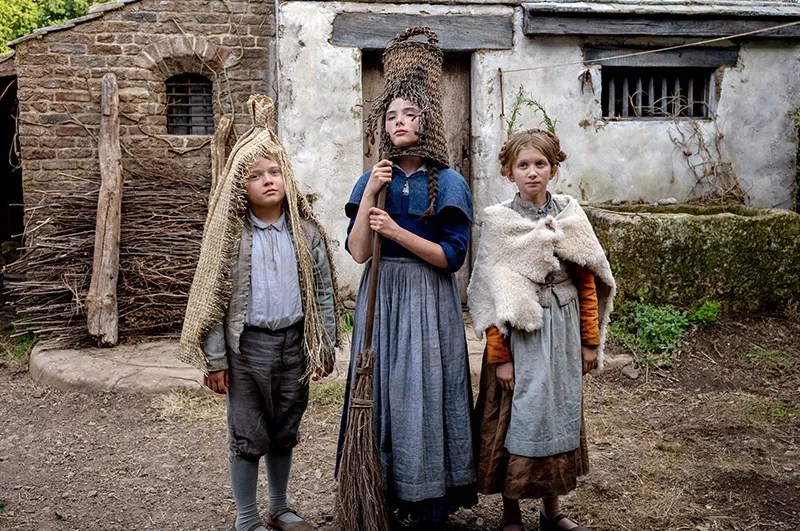
Emotions run high in a number of tear-inducing scenes: Will’s farewell to his sensitive little son (the angelic Jacobi Jupe), as he prepares to return to London; Hamnet pleading with his dying twin sister Judith (Olivia Lynes) to allow him to exchange his life for hers; the final moment of the loss of a child. The narrative authenticity, combined with the strength of Mescal and Buckley’s performances come as a shock to the system but it is a matter of individual taste and judgement as to whether they are, as some critics have argued, an exercise in emotional manipulation.
The beating heart of O’Farrell’s story, skilfully captured by Zhao’s highly visual film-making, lies less in the tragedy of bereavement than in the ultimate atonement of an absentee husband and father, in offering his grieving spouse the greatest gift possible, the return of her son.
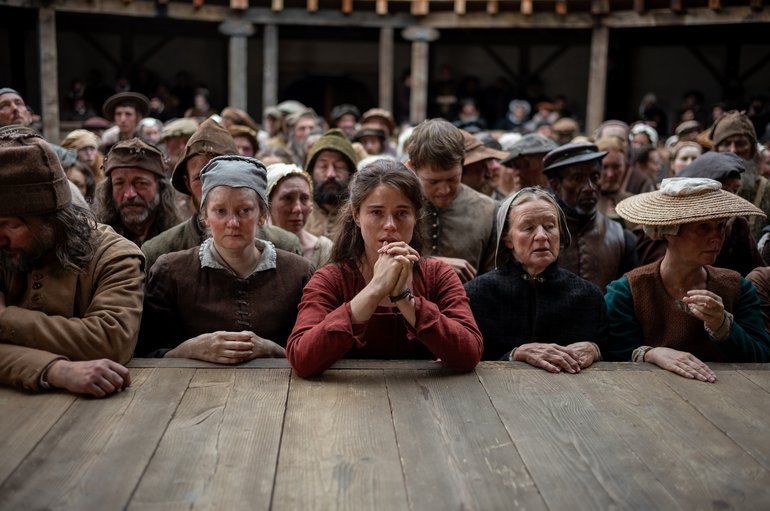
The look of wonder on Buckley’s face, as she hears the word ‘Hamlet’ spoken on the stage of the Globe Theatre, cuts to the quick. “His name”, she gasps. “They said his name”.
Little could Shakespeare or his wife have known then that this boy would reappear, over and over again, on stages across the world, for the next four centuries, and probably more.
Hamnet is dead. Long live Hamlet.

 The Even Hand